


Online Brochure
Vortex Cell
EO Destruction of PFAS
Per- and polyfluorinated alkyl substances (PFAS) are a set of synthetic chemicals that have a wide range of applications including, industrial products and waste streams. Human studies have found associations between PFAS exposure and several diseases:
Cancer.
Thyroid/endocrine system toxicity.
High cholesterol.
PFAS are extremely persistent in almost all environmental conditions, as they contain strong Carbon-Fluorine bonds. Due to their persistence and associated health risks, legislation is now being tightened worldwide with a number of PFAS already banned.
EO can significantly reduce the environmental and economic impact of PFAS treatments solutions, reducing the destruction process for 1100˚C to 30 ˚C.
EO is known to breakdown other persistent organic pollutants, including:
Ammoniacal Nitrogen.
Humic/Fulvic Acid.
Pesticides.
Wastewater by its Nature, is a Highly Variable Electrolyte
PFAS and other micropollutants are prevalent in a wide range of waste streams, including the following industries:
Pharmaceuticals.
Semi-conductor fabrication.
Data centres.
Landfills.
Chemical manufacture.
The waste streams contain different PFAS concentrations, types and co-contaminants. We believe that many EO designs are made prematurely, without adequately characterising the PFAS waste stream.
2Encapsulate have demonstrated the destruction of PFAS in the following industrial waste streams:
Landfill Leachate.
Extinguisher Fluid.


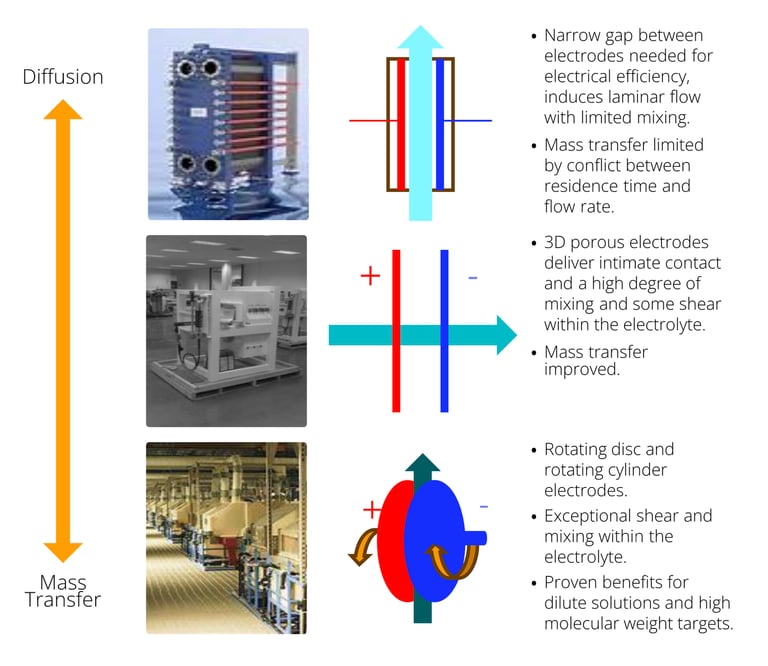
Electrolyser Trade-Off for Diffusion V Mass Transfer Limited Reactions
Diffusion: Parallel Plate Electrode (2D flow field)
Pros: Widely used, efficient and compatible with high turbidity. Works well with concentrated electrolytes, where species mobility is high.
Cons: Laminar electrolyte flow with very limited in-chamber mixing. Mass transfer limited by rapidly increasing pumping losses. Not good for organic electrochemistry, very dilute electrolytes.
Porous Electrode: (3D flow field)
Pros: Widely used, efficient. Mixed electrolyte flow with some flow induced shear. Work well with dilute electrolytes and/or where species mobility is low (organics).
Cons: Allowable electrode porosity determined by electrolyte turbidity. Susceptible to blocking.
Mass Transfer: Moving Electrode (3D Flow + High Shear)
Pros: Exceptional mass transfer via electrolyte shear. Used for extreme electrolytes (recovering ppb level precious metals from waste, removing vanadium from crude oil). Exceptional reaction efficiency.
Cons: More expensive (moving parts, seals, etc.).
Which Parts of the Navier Stokes Equation Should You Focus on? Is The Levich Equation Relevant?
Solution: Vortex Characterisation Cell
Introducing the first EO Characterisation Cell developed to unlock EO efficiency for waste stream variabilities. Our characterisation cell provides rapid qualitative analysis of the relative importance of shear, residence time and concentration variations for PFAS destruction rates.
Objectives: Qualitative characterization of Mass Transport v Diffusion during EO.
Characterise your PFAS waste streams, so you can select the best electrolyser.
Evaluate and select the best performing electrodes from our expanding range of Ebonex® and EboNext® Andersson-Magneli Phase materials and coatings.
Characterise waste stream variability in real-time.
Manage PFAS mineralization rates of your EO process.
EboNext Vortex Characterisation System
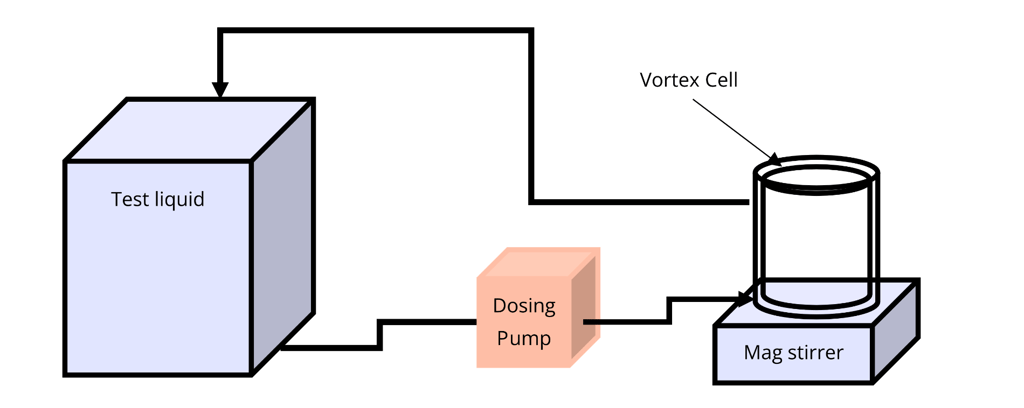
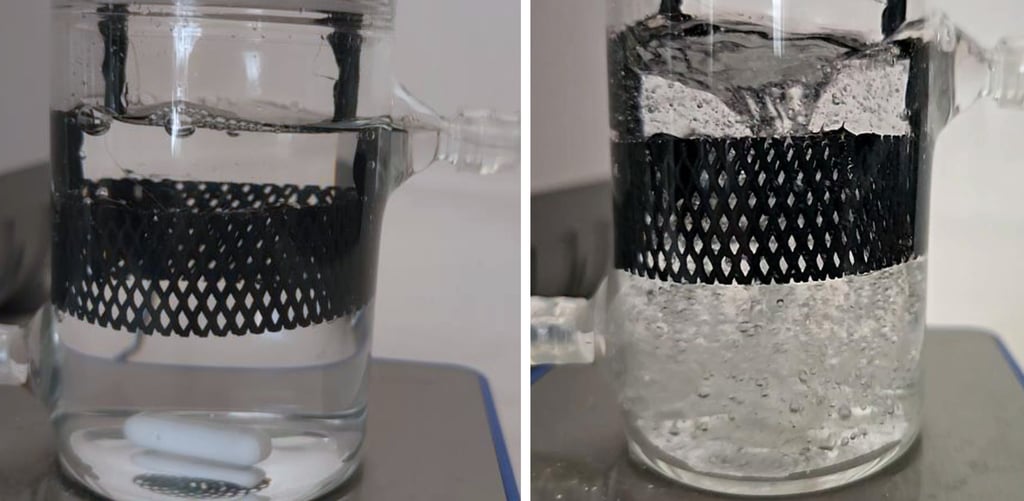
Small configurable beaker cell(s) provide a rapid qualitative analysis of the relative importance of shear, residence time and concentration on PFAS destruction rates.
Stirred reactor, with a high precision metering pump.
Cylindrical Ebonex® coated mesh electrodes form an annular 3D reaction zone.
Metered flow rate determines residence time.
Stirring creates a vortex inside the reaction zone.
Varying the stirring rate, delivers a rapid qualitative determination of the balance between Diffusion and Mass Transfer limited reactions.
Vortex process characterization cell
Ebonex® coated mesh electrodes.
Annular reaction zone.
Simple magnetic stirrer.
Peristaltic feed dosing pump.
Characterisation: For Diffusion V Mass Transfer Limited Reactions
Vortex Characterization Cell: Real-time insights giving you the information to be a step ahead at each stage. Ebonex® and next generation EboNext® electrodes provides increased stability and longevity of EboNext® coatings.
Matched electrode pairs forming fixed and repeatable annular reaction chamber, supporting exceptional operating ranges in flow-through and vorticity/shear.
Electrode pairs quickly swapped out to evaluate specific coating/effluent combinations.
Fully self-cleaning through periodic current reversal – eliminates deposit build-up on the electrode surfaces.
EBONEX® and EBONEXT® are the Leading and Most Trusted Andersson-Magnelli Phase Electrode Materials
QuanVerge Inc., the developers of the Ebonex® and EboNext® products, have a 35-year track record in developing and supplying Andersson-Magneli Phase conducting ceramics.
Free of contaminating carbon and/or alkali metal residue from alternative production methods.
Supporting and leading ongoing research by >>17 Advanced EO teams, across multiple applications.
High volume supply chain established and live in the US, EU and UK.
Ebonex® and EboNext® are the registered trademarks of QuanVerge Inc.
2Encapsulate Limited
A fully integrated and environmentally-friendly chemical remediation provider producer and distributor of PFAS and micropollutant technology solutions.
Our Offerings include:
PFAS Remediation Solutions
Electrochemical oxidation for PFAS destruction.
Ion Exchange PFAS capture.
Ion Exchange resin regeneration.
Change out and disposal of exhausted sorbent Beds.
PFAS, Environmental and Waste Consultancy
O-Series: Lower lifecycle costs for your existing PFAS treatment solutions.
T-Series: From PFAS awareness to treatment implementation.
Additional modules supporting the O and T series work.
Hazardous Waste assessment and treatment pipeline.
Vortex Cell – Request Brochure.
Rapid small-scale characterisation of waste streams.
Acronyms clarified
PFAS (Per- and polyfluoroalkyl substances)
DWI (Drinking Water Inspectorate)
EA (Environment Agency)
CAPEX (Capital Expenditure)
OPEX (Operational Expenditure)
PFD (Process Flow Diagram)
P&ID (Piping and Instrumentation Diagram)
IX (Ion Exchange)
AEOP (Advanced Electrochemical Oxidation Process)
GAC (Granular Activated Carbon)
ESA (Environmental Site Assessment)


Take Action
Address
London, United Kingdom
Contact


Copyright © 2026 2Encapsulate Limited. All rights reserved.
Useful Links
Social Media
Website built by ricardon.co.uk
Company number: 14883182